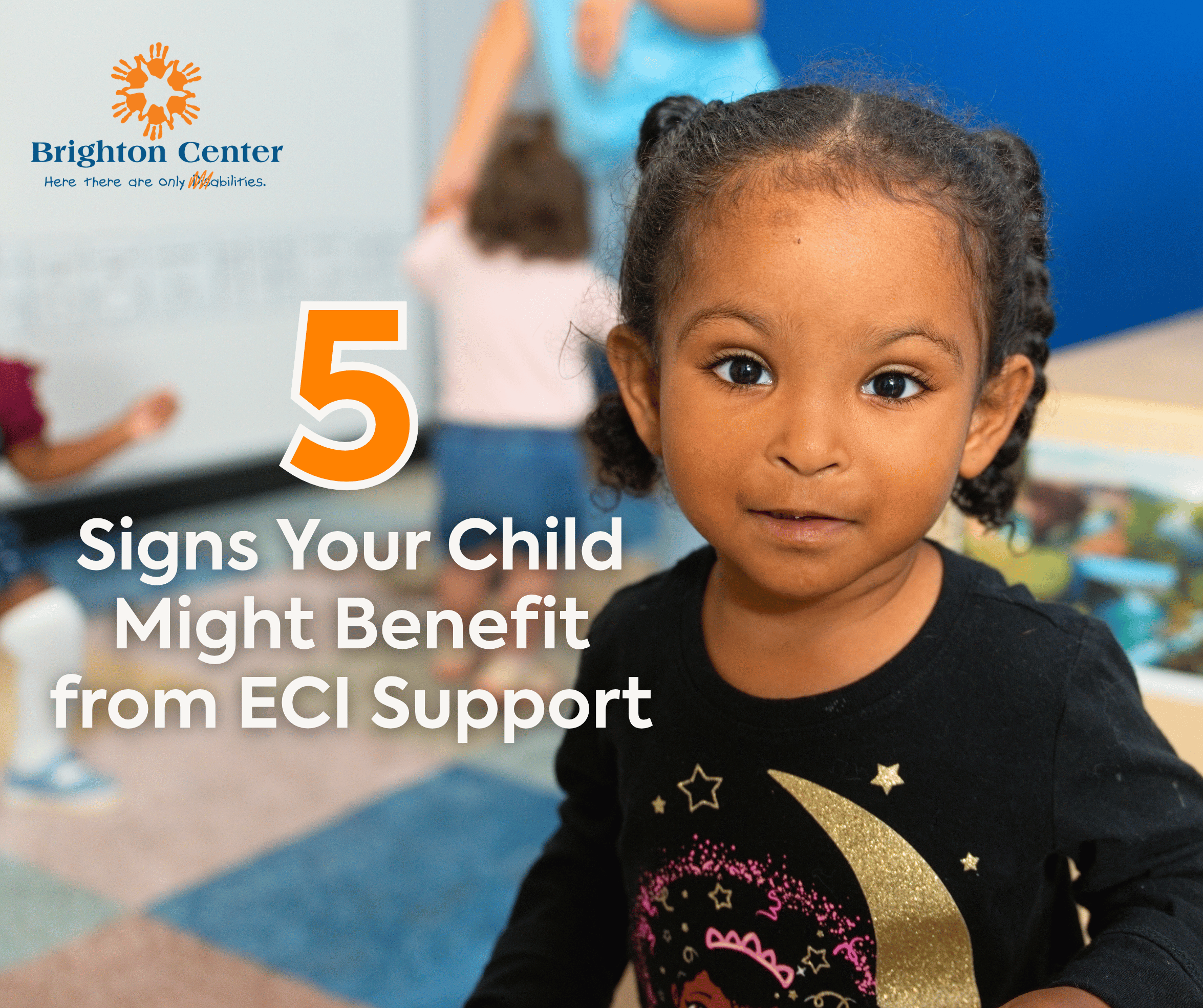
If you’ve ever wondered, “Is this normal?” about your baby or toddler’s development, you may be asking exactly the right question. Knowing when to look into ECI support can feel confusing, especially when everyone has an opinion about when children “should” reach milestones. Every child grows at their own pace, and asking questions is a strength, not an overreaction. Here are five signs your child might benefit from extra support, and what to do next.
What Is ECI Support?
Early Childhood Intervention (ECI) is a Texas program that serves children from birth to 36 months who have a developmental delay or a qualifying medical diagnosis. At Brighton Center, our early childhood intervention program offers physical, occupational, and speech therapy for babies and toddlers ages 0-3, based on each child’s needs, with parents as partners every step of the way.
Families also work with an Early Intervention Specialist (EIS), a credentialed professional who specializes in infant and toddler development. Through Specialized Skills Training, an EIS coaches families to build strategies into everyday routines and connects them with community resources.
5 Signs Your Child May Benefit
One missed milestone doesn’t always mean a delay, but if you notice any of these signs, especially if they continue, it’s worth asking for an evaluation.
1. Communication Delays
You might notice your child babbles very little, isn’t using words yet, or has a hard time showing you what they want or need. Communication is the foundation for learning and connection, so an early look can make a real difference. Speech-language therapy can help children build these skills, and ECI support can begin well before a child’s first words.
2. Motor Skill Delays
Your baby may not be rolling or sitting yet, or your toddler may be slow to crawl or walk. Movement is how children explore their world, so these delays are worth discussing with a pediatrician. Depending on a child’s needs, physical therapy can support strength and mobility, while occupational therapy can focus on fine motor skills.
3. Feeding or Sensory Challenges
Mealtimes may feel stressful, or everyday sounds, textures, or touch may seem to overwhelm your child. Feeding and sensory differences can affect comfort, routines, and daily life, and speech-language therapy and occupational therapy may both help. If your child is choking or has trouble swallowing, contact your medical provider promptly.
4. Limited Social Engagement
You may notice little eye contact, limited response to their name, or less interest in interacting with others. Early connection is how children learn to communicate and build relationships, so these signs deserve attention. An EIS can help you understand your child’s social-emotional development and build support into your daily routine.
5. Loss of Skills or Missed Milestones
If your child stops doing something they used to do, like babbling, using words, or responding to you, don’t wait. Losing previously acquired skills, significant delays across several areas, or limited response to sounds or visual stimulation should prompt you to seek an evaluation right away. Urgent medical concerns should always be evaluated by a healthcare professional.
Why Acting Early Matters
The first three years are a critical window. A child’s brain grows more rapidly during this time than at any other stage of life, laying the foundation for learning, communication, and relationships. That’s why “wait and see” can delay valuable support, and why we encourage families to reach out as soon as concerns arise.
Families often worry that their child needs a formal diagnosis, that something is seriously wrong, or that their child will simply catch up on their own. A diagnosis is not required to request an evaluation, and ECI is designed to provide support, not labels. We partner with families, celebrate each child’s strengths, and offer individualized guidance.
Not sure what you’re seeing? Our team is happy to talk it through.
What Does ECI Look Like?
ECI services happen in your child’s natural environment, typically your home, a childcare center, or another familiar community setting. Sessions focus on your child’s goals through everyday routines like playing, eating, getting dressed, and using the toys and items already in your child’s world. Our providers use a family-centered coaching approach, partnering with you to build on what you’re already doing so you feel confident creating learning opportunities between visits.
Services are guided by your child’s Individualized Family Service Plan (IFSP), and not every child receives every therapy. ECI can continue until your child’s third birthday, with transition planning for what comes next.
Want to see ECI in action? Watch Hannah’s story.
ECI Support FAQ
Do I need a doctor’s referral for an ECI evaluation?
No. A doctor’s referral isn’t required, and neither is a formal diagnosis. Parents and caregivers can contact Brighton Center directly to request an ECI evaluation if they have concerns about their child’s development. Referrals can also come from pediatricians, hospitals, childcare providers, Child Protective Services, and other community professionals.
What happens during an evaluation?
After a referral, an ECI Referral Coordinator contacts you to review your concerns and schedule an evaluation. An EIS and a therapist (occupational, physical, or speech-language) meet with you and your child to determine eligibility and identify your child’s developmental needs. If your child is eligible, you and the team develop your Individualized Family Support Plan (IFSP). Texas ECI programs are required to complete these steps within 45 days.
What does an early childhood intervention program cost?
ECI services are available to eligible families regardless of income or insurance status. Evaluations, assessments, service coordination, IFSP development, and interpretation services are provided at no cost. Other services may be covered through Medicaid, private insurance, or Texas’s Family Cost Share system, which determines a family’s maximum monthly payment based on income and family size. No family is denied ECI services due to an inability to pay.
Take the First Step
You know your child best, and you don’t have to wait for a diagnosis or a significant delay to ask questions about development. Early intervention can make a meaningful difference, and reaching out is a proactive step toward helping your child reach their full potential. If you have concerns, trust your instincts and contact Brighton Center.
Get started with ECI support or learn more about Brighton Center’s ECI program.
This post is for educational purposes only and is not a substitute for a professional evaluation.