Every parent wants to give their child the best possible start in life. For many families, this includes the goal of breastfeeding—a journey that can be filled with both beautiful moments and unexpected challenges.
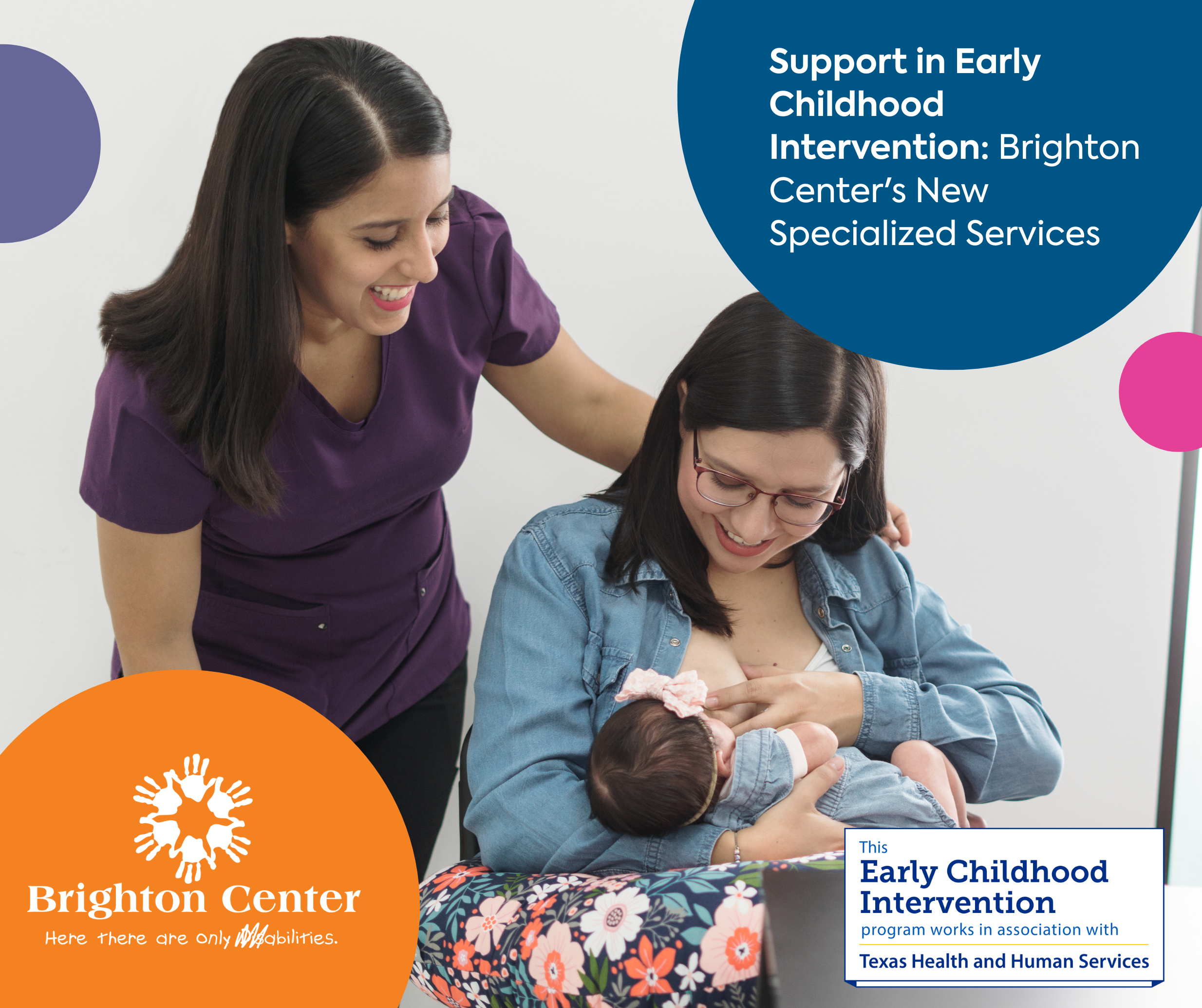
At Brighton Center, we understand that breastfeeding success isn’t just about nutrition; it’s about supporting the entire family during one of life’s most important developmental windows. That’s why we’re excited to share how two of our experienced team members have expanded their expertise to provide more comprehensive breastfeeding assistance within our Early Childhood Intervention (ECI) program.
Ashley Gibbons and Alyssia Escamilla, both seasoned speech-language pathologists at Brighton Center, have recently earned their certifications as lactation consultants, creating a powerful new dimension to our family-centered care. This expansion comes at a pivotal time, as groundbreaking legislation (HB136) now makes Medicaid coverage available for lactation services, ensuring professional breastfeeding help is accessible to more San Antonio families than ever before.
Expanding Expertise: Our Lactation Specialists
Ashley Gibbons, M.S., CCC-SLP, CLC, brings a unique perspective as Brighton Center’s ECI Lead Speech-Language Pathologist and newly certified lactation consultant. With over nine years as a speech-language pathologist and six years with Brighton Center, Ashley’s journey into lactation care began with her own personal experience.
“I had a few breastfed babies on my caseload, but it wasn’t until I had my own daughters that I really developed a deep interest in lactation and breastfeeding,” Ashley shares. “I was lucky enough to have access to lactation counselors who were able to turn my experience around—initially, it was not an easy journey for me!”
Now, Ashley combines her extensive experience in infant feeding with her new certification as a lactation consultant through the Academy of Lactation Policy and Practice (ALPP). “I’m excited to pair my experience as an SLP to aid the child’s feeding abilities with my newly acquired knowledge as a CLC to assist with lactation management and the breastfeeding dyad.”
Alyssia Escamilla, M.S., CCC-SLP, CLC, has been a speech-language pathologist since 2019 and joined Brighton Center’s Early Childhood Intervention team in 2021. Her decision to become a certified lactation consultant was driven by a deep commitment to help guide families through the obstacles feeding can present.
“I became a Certified Lactation Counselor in addition to being an SLP because I wanted to further support babies and families in their feeding journey, and I have a particular interest in infant feeding,” Alyssia explains. Like Ashley, she earned her CLC certification through the Academy of Lactation Policy and Practice (ALPP).”
What makes both Ashley and Alyssia uniquely qualified is their dual expertise. “Our approach is unique because we hold both the CLC and SLP license,” Alyssia notes. “Not only can we provide lactation guidance for parents, but we are able to assess, diagnose, and treat any other potential feeding issues, as well as address other feeding milestones such as chewing and straw drinking.”
Understanding the Breastfeeding Dyad in Early Intervention
Both consultants emphasize the importance of understanding the “breastfeeding dyad”—the concept that successful breastfeeding involves helping both the infant and mother as one interconnected unit.
Ashley explains it as “the infant-mother pair as one unit made of two separate parts. It’s the symbiotic relationship between the two that makes breastfeeding successful.”
Alyssia offers a relatable analogy: “The way I explain it to families is it’s similar to walking—the right leg and left leg have separate roles but work together to complete one job. The breastfeeding dyad aids the child’s early development, as a well-fed infant has the strength and energy to meet other milestones, like rolling and sitting.”
This perspective becomes particularly important when working with children who have developmental differences. “For children with developmental delays, other breastfeeding challenges include children with low or high tone, uncoordinated suck, swallow, breathe pattern, difficulty maintaining a latch, aspiration, insufficient milk transfer, and sensory processing concerns,” Alyssia explains.
The Brighton Center Difference: Integrated ECI Lactation Care
What sets Brighton Center’s lactation services apart is its seamless integration with our existing Early Childhood Intervention services. Our speech-language pathologists’ dual expertise provides comprehensive assistance that addresses both lactation management and feeding development.
“As SLPs, we are able to assess and treat not only issues with breastfeeding, but issues with coordination and strength of the muscles used for breastfeeding, tethered oral tissues, and swallowing and reflux concerns,” Alyssia notes. “We also have access to interprofessional collaboration with our Physical Therapists, Occupational Therapists, and Early Intervention Specialists to provide holistic and collaborative guidance.”
Our approach follows the early intervention’s evidence-based coaching model. “Early intervention services are built upon the coaching model, where we as clinicians support the caregivers in developing skills and strategies to help their children, rather than only working directly with the child,” Ashley explains. “With lactation counseling, hands-off counseling is evidence-based and best practice as well. I want the parent to be the hero in their family’s story.”
Additional advantages include:
In-Home Services: We bring lactation services directly to families in their most comfortable environment, allowing us to observe and assist with breastfeeding in the family’s natural setting.
No-Cost Evaluations: Following our ECI model, we provide evaluations at no cost to families, removing financial barriers that might prevent parents from seeking help early.
Coordinated Care: Because we’re already working with families through ECI, we can address feeding concerns as they arise during regular developmental care, creating seamless continuity of care.
Making a Difference in Feeding Journeys
Our lactation consultants address a wide range of breastfeeding challenges. “Common breastfeeding obstacles in infants and toddlers include an improper latch, pain at the breast during feeding, milk supply worries, fatigue or falling asleep while eating, and slow weight gain or weight loss,” Alyssia shares.
The impact of specialization can be transformative. Alyssia recalls helping “a mother have success in breastfeeding a child with low tone by figuring out different positions and accessories that aid the baby’s body, so mom and baby’s focus can be on the feeding.”
Ashley has seen similar results: “It’s amazing to see a mom who has been dreading the pain during feeding make a small adjustment and realize that nursing can be pain-free!”
Each lactation consultation session begins with what Alyssia calls “active listening, where we hear a parent’s concerns for their child and what their goals are, and ask further questions when needed to collaborate on how to best help the family.”
When to Seek Lactation Services
Both consultants encourage families to reach out early and trust their instincts. “I tell families to reach out for help as early as they feel comfortable,” Alyssia advises. “Specific signs for when help may be needed include pain while breastfeeding, weight loss, consistently falling asleep during feedings, coughing or watering eyes while feeding, or difficulty latching.”
Ashley echoes this sentiment: “I want to empower anyone who has any questions about breastfeeding and infant feeding to reach out for an evaluation as soon as they feel like something is not quite right. Breastfeeding is the most natural thing you’ll ever have to learn—it’s okay to ask for help!”
According to CDC data, while more than 80% of mothers in the United States initiate breastfeeding, rates drop steadily after families leave the hospital, suggesting that families need additional community-based assistance—exactly what Brighton Center provides.
A New Era of Accessible Support
The implementation of HB136 represents a significant advancement in making lactation care accessible to all families. “Medicaid now covering lactation counseling for families is amazing!” Alyssia enthuses. “This makes breastfeeding care more accessible to families of different abilities and socioeconomic statuses. With lactation support being covered through Medicaid, we can now help families earlier in their feeding journeys.”
Ashley, having navigated accessing lactation assistance herself, also understands the enormous impact: “As someone who had to navigate accessing a lactation counselor, the cost and availability were the factors that hung over me when making a decision when and where to go.”
This new legislation removes those barriers, ensuring that financial concerns no longer prevent families from getting the professional guidance they need.
Building Confidence Through Education and Guidance
At Brighton Center, our approach to lactation care aligns perfectly with our family-centered philosophy. “Everything we do at Brighton is family-centered,” Alyssia explains. “We believe the family is the child’s primary therapist and we are here to educate, guide, and encourage them to help reach their child’s full potential.”
Alyssia believes that “empowerment comes from knowledge, practice, encouragement, and accessibility. We encourage parents to use us as a resource for their concerns and questions.”
Whether you’re just beginning your breastfeeding journey, facing unexpected challenges, or looking for guidance as your child grows and develops, our team brings both clinical expertise and genuine understanding to help meet your family’s unique goals.
Ready to learn more about lactation support through Brighton Center’s Early Childhood Intervention program? Contact us at 210-826-4492 or complete our online referral form. Our team is here to assist you and your family during this important journey.